Rubber-covered rollers
Print, paper, film, steel-line and conveyor rollers: the old covering comes off the core before it is re-covered.
Rubber removal · Rollers, wheels & bonded parts
Old rubber taken off the metal core with heat, ready for re-covering, re-bonding or recycling. Done at Arena Comet UK near Stoke-on-Trent in a 5 m × 2 m × 2 m pyrolysis oven, without grinding or cutting into the core.
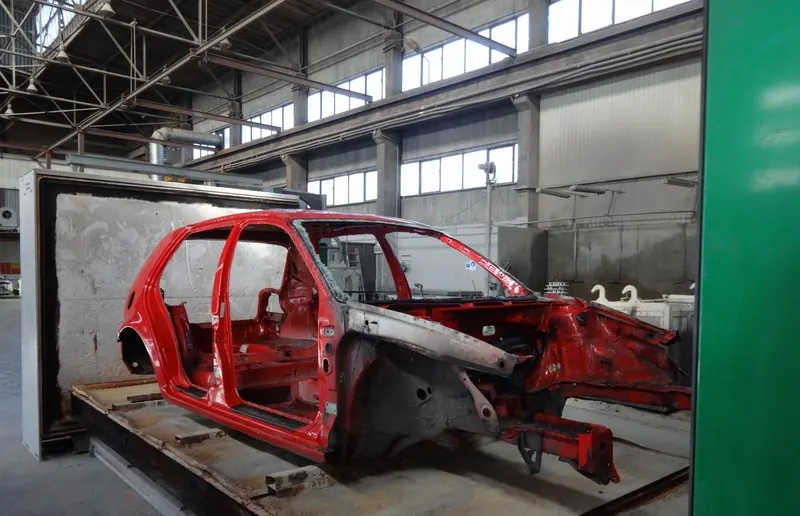
Rubber removed thermally, not by grinding
Long rollers in one piece
Collection & return can be arranged
Quote from a photo and dimensions
What we strip
Rubber and similar coverings are removed from steel and other heat-resistant metal cores. Typical work:
Print, paper, film, steel-line and conveyor rollers: the old covering comes off the core before it is re-covered.
Rubber or polyurethane tyres bonded to steel or cast hubs, for reclaiming the metal hub.
Rubber-to-metal bonded bushes, engine and motor mounts, so the metal can be reused or recycled.
Rubber-lined pump casings, impellers, valve bodies and pipes that need the lining removed.
Rubber-lined plates and chute or tank linings within the size of the chamber.
Rubber residue on moulds, press plates and tooling from rubber manufacturing.
What to tell us
Rubber removal is assessed per job, because rubber compounds behave differently when heated. To quote quickly we need:
If you know it: natural, nitrile, EPDM, silicone, polyurethane. Chlorinated and fluorinated rubbers need to be discussed first.
Steel, cast iron or aluminium, and any coating or plating on the core.
Diameter, length and weight of one piece, and how many.
Bearings, seals, shafts or heaters. These are normally removed before heating.
A photo or measurement of how much rubber is on the core.
One-off or regular batches, for example a roller re-covering shop.
How it works
Cutting, grinding or peeling rubber off a core is slow, heavy work and can damage the core surface. Pyrolysis breaks the rubber down with a controlled thermal cycle instead.
The part is loaded into the oven and heated on a programme chosen for the core and the rubber. The rubber starts to break down.
With little oxygen in the chamber, the rubber breaks down into gases instead of burning on the part. The gases are destroyed in an afterburner.
A final controlled stage removes the carbon left behind, leaving a light, loose ash on the metal.
Ash is rinsed or blown off, the part is cooled slowly and checked. Blasting the core ready for re-covering can be arranged on request, see the finishing options below.
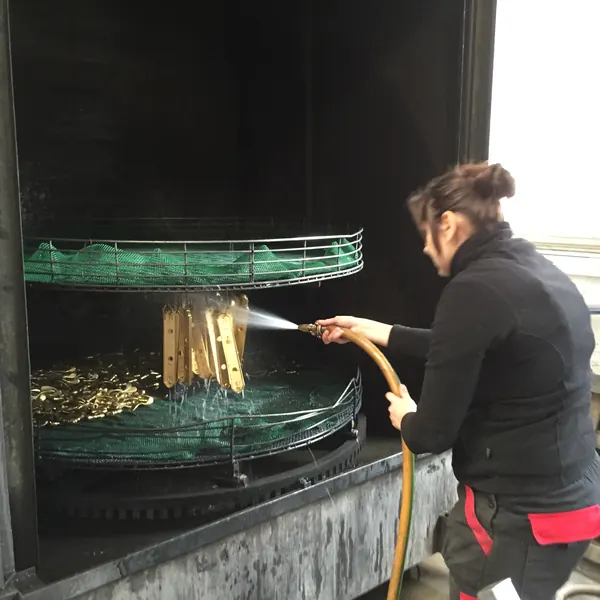
After the oven
After pyrolysis the parts can go straight back to you. If you need them cleaner, or ready for re-coating or re-covering, a finishing step can be added. Blasting is available on request and can be arranged for UK customers. We confirm what is possible when we quote and agree it with you per job.
Parts go back to you as they come out of the oven. Very often, but not always, with a light ash or dust residue on them, which many customers simply blow, wipe or wash off themselves.
Ash and loose residue washed off with a high-pressure washer, so the parts come back visibly clean.
Fine holes, mesh and tight channels cleaned in an ultrasonic bath after the oven. Suited to precision parts.
On request. A gentle blast for delicate parts, leaving a clean, even finish.
On request. Takes off the last residue and leaves the metal with a uniform, slightly rough surface.
On request. A heavier blast for robust steel parts that must go back into the line or be re-coated.
Typical for rubber cores that are going to be re-covered: shot or sand blasting arranged on request after the oven, so the core is ready for your roller specialist. We remove the rubber and prepare the core; the re-covering is done by your roller specialist.
Why Arena Comet UK
5m × 2m × 2m
Rollers up to the length of the chamber go in whole. No cutting rubber off in sections.
Parkhouse Industrial Estate, Newcastle-under-Lyme, near Stoke-on-Trent, with quick access to the M6 via the A500. Well placed for the Midlands and the North West.
We look at the rubber type, the core and the quantity before we agree to a job, so there are no surprises on either side.
Arena Comet designs and builds thermal cleaning equipment and runs cleaning centres in Belgium, the UK, France, Poland and the Czech Republic.
Your enquiry is handled by a technical sales partner who knows the oven and the site.
From enquiry to clean part
Photo, dimensions, weight and material via the form below.
You receive a price and lead time for the job.
Drop off in Newcastle-under-Lyme or we arrange collection.
Pyrolysis cycle programmed for your part.
Ash removed and the part checked before release.
Packed and returned, ready for your next run.
FAQ
With heat. The roller is heated on a controlled programme so the rubber breaks down into gas and a light ash, which is blown or rinsed off. This avoids cutting, grinding or peeling the rubber off by hand, which is slow and can mark the core.
Bonded rubber is hard to peel because it is chemically attached to the metal. Thermal cleaning breaks the rubber down instead of pulling it off. Send a photo and the rubber type if you know it, and we will say whether it is a good fit.
Common rubbers and polyurethane covers on metal cores are the typical work. Some materials give off corrosive or hazardous gases when heated, for example chlorinated or fluorinated rubbers, so we assess every job before we accept it.
The metal core is kept intact when the programme is matched to it. Bearings, seals, plastic parts and heaters should be removed first, and aluminium or plated cores need to be discussed. Tell us what is fitted.
No. We remove the old rubber from the core. If you need a new covering, your roller recovering specialist can take the clean core from there.
The chamber of the Santana pyrolysis oven is 5 m long, 2 m wide and 2 m high. Send the length, diameter and weight and we will confirm it fits.
Your technical contact
Your parts are cleaned by Arena Comet UK in Newcastle-under-Lyme, and you deal with Bart. He installed and maintained Arena cleaning machines at customer sites as a field service technician, and later started up and ran Arena's UK cleaning centre in Stoke himself. He gives you honest advice on whether a part suits pyrolysis, answers quickly and follows the job from first photo to return.
+32 472 79 31 43 · bart.joris@tuneitup.be
Official sales partner of Arena Comet UK Ltd (company no. 13989168) · TuneItUp BV, company no. BE 1043.282.906, Noordlaan 10A/8, 9200 Dendermonde, Belgium.
Other services
Request a quote
The more we know, the faster and more accurate the quote: overall dimensions, weight, the material and how much build-up there is.
Opening hours: Mon–Fri, 08:00–16:00
Bart Joris: +32 472 79 31 43 · bart.joris@tuneitup.be
Enquiries via this website are handled by TuneItUp BV, official sales partner of Arena Comet UK Ltd.